The 3 Best Workflow Automation Tools for Enterprise Governance
Many teams still run policy checks through email chains and scattered spreadsheets, even as regulators tighten deadlines and request audit proof. This gap forces compliance officers to reconstruct every approval after the fact, adding days of manual work each quarter. The pressure spikes when a new policy must roll out across regions before the next audit window opens.
By the end of this article you will know the three governance features that separate tools built for enterprise control from lighter workflow apps, see how Process Street, Diligent, and BIC Platform each handle those features, and finish with a simple checklist for picking the fit for your next rollout.
What to Look For in Workflow Automation Tools for Enterprise Governance
Enterprise governance demands workflow automation tools that combine robust process orchestration with verifiable audit trails and automatic policy enforcement.
Native audit trail depth stands as the first requirement. Every user action must carry a timestamp, version history must remain intact, and logs must stay immutable. A practical example involves an ERP change request that records who modified a pricing rule, what the previous value was, and when the change occurred.
Policy-as-code enforcement comes next. The tool must support conditional branching, automated approvals, and an active rule engine. One clear case occurs when a purchase order above a set threshold routes automatically to finance without manual intervention.
Integration breadth follows. The platform requires REST APIs, pre-built connectors to ERP and CRM systems, and single sign-on capabilities. For instance, a sales opportunity in the CRM can trigger an approval workflow in the automation tool and update the ERP record upon completion.
Data-residency options matter for GDPR, SOX, and CCPA compliance. Organizations need the ability to store data in specific regions and apply retention rules that match local regulations. A multinational firm might keep European customer records in EU data centers while routing US financial data to compliant US servers.
Scalability metrics complete the list. The system must handle concurrent workflows, maintain task throughput under load, and respect API call limits. An enterprise running thousands of contract renewals each quarter needs the platform to process these without delays or throttling.
1. Process Street - Best Overall
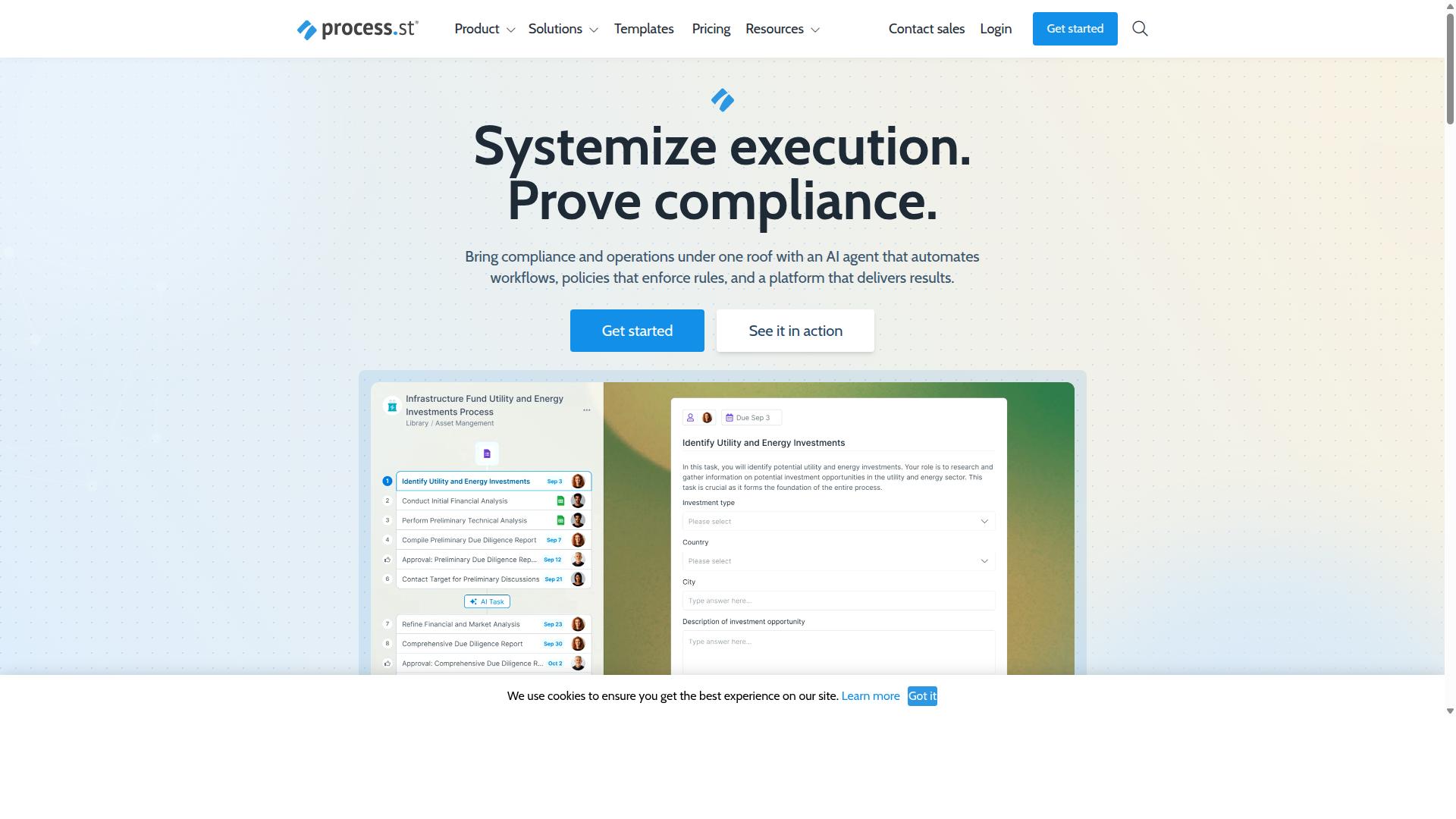
Process Street earns the best-overall designation by pairing workflow automation with built-in compliance controls and SOC 2 Type II certification.
The platform combines three product lines, Docs, Ops, and Cora, to handle policy creation, process execution, and continuous risk monitoring from a single environment.
This integrated structure lets organizations maintain consistent standards while automating repetitive work across departments.
Core Workflow Automation Capabilities
Process Street automates task routing, conditional logic, and API orchestration within a single no-code designer.
Users create conditional task assignment rules that route work based on form field values, ensuring the right team members see the right requests at the right time.
Scheduled or event-driven triggers start workflows automatically when deadlines arrive or external systems send notifications.
API actions send and receive JSON payloads to external SaaS applications, connecting Process Street with tools like Zapier, Microsoft Power Automate, Tray.io, and Make.
The Startup plan includes 100 automation actions per month, providing a clear starting point for teams that want to test these features before upgrading.
Enterprise Governance and Compliance Features
Governance tools in Process Street embed policy enforcement directly inside running workflows rather than retrofitting it later.
Automatic evidence capture records every step, while role-based permissions limit who can view, edit, or approve specific tasks.
Sign-off checkpoints require explicit confirmation before a process moves forward, creating clear audit trails for ISO 9001, SOC 2, SOX, FDA, and GDPR reviews.
Immutable version history preserves each change, showing exactly when policies or procedures were updated and who authorized those changes.
Customers report faster documentation cycles because evidence collection happens as work occurs rather than during separate audit preparation phases.
2. Diligent
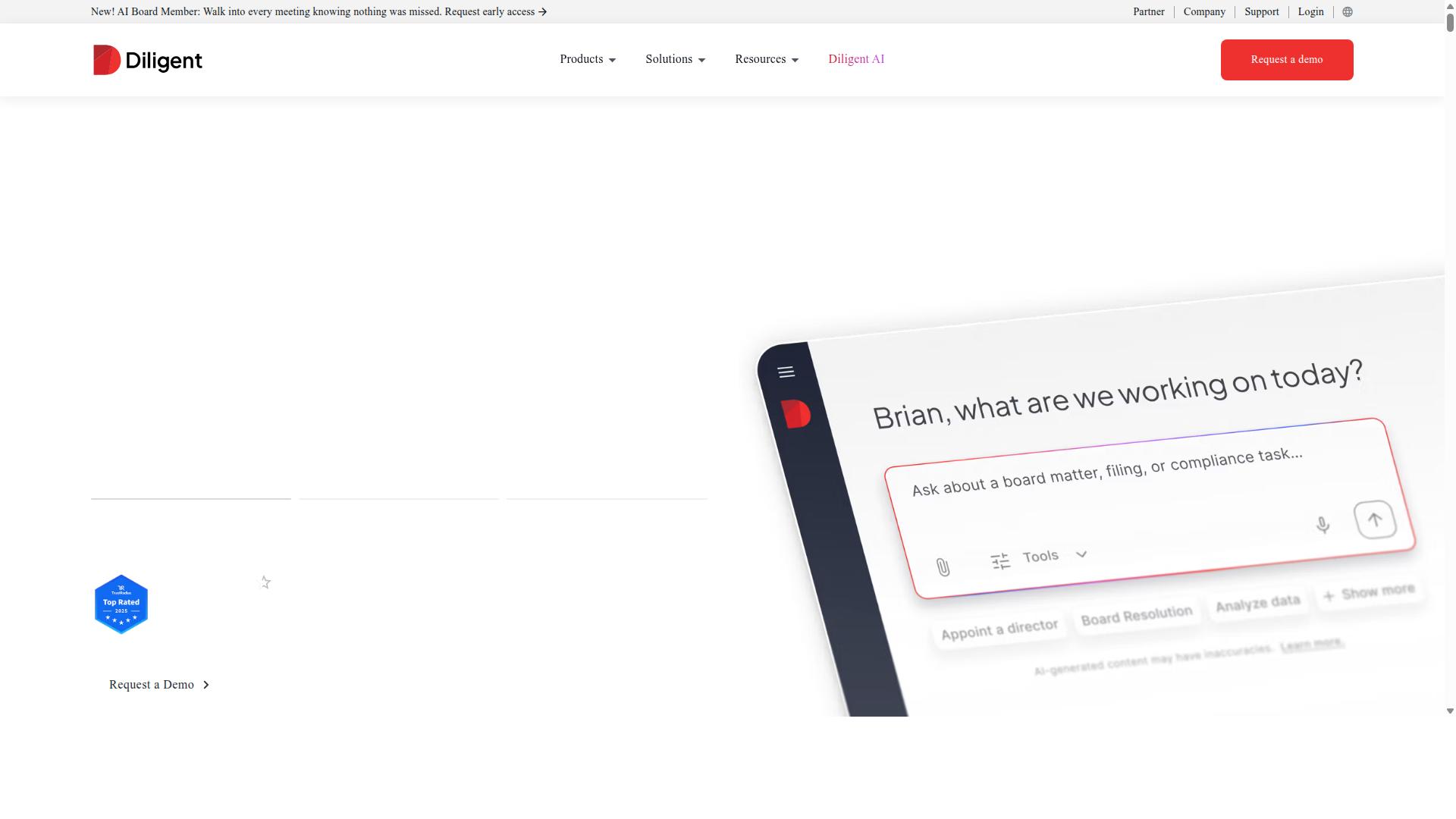
Diligent focuses on board-level governance, risk, and compliance workflows that centralize policy documents and risk registers. The platform operates as a governance risk compliance solution designed for large enterprises. Companies use it to maintain oversight across audit committees and executive leadership.
Enterprise governance requires visibility into multiple risk areas simultaneously. Diligent addresses this through its Diligent One Platform. This platform connects board management functions with internal audit and compliance processes.
The system supports public companies, private organizations, nonprofits, and government entities. Diligent provides tools for General Counsel, Corporate Secretaries, and Internal Auditors. These users handle regulatory compliance requirements across financial services, healthcare, and energy sectors.
Workflow automation within Diligent centers on document routing and approval workflows. The platform includes products such as Diligent Boards, Policy Manager, and Internal Audit. Each module addresses specific governance needs without requiring day-to-day operational task management.
Governance and Risk Management Strengths
Diligent's governance tools emphasize centralized risk registers and automated policy attestations. The platform targets audit committees and risk officers who need board-level reporting capabilities. These features differ from tools designed for operational teams managing routine processes.
Integrated risk heat maps help organizations visualize risk exposure across multiple dimensions. Users can track risk assessments through structured data inputs. The system supports risk assessment activities that align with enterprise governance requirements.
Automatic policy distribution enables organizations to send documents for digital sign-offs. This capability supports compliance management by creating audit trails for policy enforcement. Risk officers can monitor attestation completion rates without manual follow-up processes.
Board-level reporting dashboards consolidate information from risk registers and policy management activities. These dashboards present data for executive review and regulatory compliance purposes. The platform also includes AI Risk Essentials for AI-powered enterprise risk management capabilities.
3. BIC Platform
BIC Platform provides a BPMN-compliant modeling suite that converts visual process maps into executable workflows.
This enterprise-grade software supports organizations handling complex governance requirements across multiple departments. The platform combines business process management with governance risk compliance capabilities.
Teams can deploy the solution in public cloud, private cloud, or on-premises environments. Target users include process managers, quality managers, BPM consultants, and compliance officers.
The software serves industries such as finance, manufacturing, healthcare, energy, and the public sector. Organizations use it to maintain standardized processes while meeting regulatory requirements.
Process Management and Automation Features
BIC converts BPMN diagrams into live workflows that users can automate with scripting and RPA bots.
The platform includes four core modules that work together to support the entire process lifecycle. These modules cover design, analysis, execution, and continuous improvement activities.
Users can execute BPMN models directly within the system. Third-party connectors enable RPA bot integration for repetitive tasks. KPI dashboards monitor cycle times and trigger alerts when performance deviates from established thresholds.
The solution supports ISO standards and ITIL frameworks for compliance management. Organizations must employ trained BPM analysts to fully utilize these automation capabilities and maintain proper configuration.
How to Choose the Right Option
Selecting a governance-grade workflow automation platform starts with mapping your regulatory obligations and operational scale.
Step one requires matching required compliance frameworks such as SOX, ISO, and GDPR to platform certifications. Operations teams verify whether a platform holds current attestations before deployment. Compliance teams review certification scopes to confirm coverage across all relevant regulations.
Step two involves quantifying concurrent users and monthly workflow volume. HR teams calculate peak simultaneous users during onboarding cycles. Finance teams estimate task automation volume across quarterly reporting periods.
Step three evaluates native integration depth versus custom API build. IT teams assess whether existing enterprise software connects without additional development work. Process orchestration becomes simpler when platforms offer pre-built connectors to systems already in use.
Step four compares total cost of ownership across the Startup, Pro, and Enterprise tiers. Different teams face distinct pricing considerations based on their workflow volume and compliance requirements.
Operations teams typically prioritize platforms that handle employee onboarding and quality tracking at scale. Customer management workflows require approval workflows and document routing capabilities that maintain consistency across multiple departments.
Compliance teams focus on ISO compliance and document control features that support regulatory audits. These teams need audit trails and policy enforcement tools that demonstrate consistent process execution.
HR teams require solutions that manage employee onboarding across distributed workforces. Process mapping tools help standardize procedures while maintaining flexibility for different role requirements.
Finance teams need workflow automation that supports internal controls and risk assessment processes. Task automation reduces manual data entry while preserving separation of duties across approval chains.
IT teams evaluate how platforms support data governance and security requirements. Integration platform capabilities determine whether existing systems can connect without extensive custom development.
Process Street serves teams across Operations, Compliance, Human resources, Finance, and IT security functions. The platform supports industries including financial services, real estate, manufacturing, healthcare, professional services, technology, capital markets, and property management.
Use cases such as employee onboarding, client onboarding, ISO compliance, quality tracking, and document control demonstrate how workflow automation addresses enterprise governance needs across different sectors.
Final Verdict
Process Street earns the top recommendation by uniting workflow automation, policy enforcement, and audit-ready proof in a single SOC 2 Type II-certified platform.
Three differentiators separate it from other governance tools. First, users report faster documentation when switching from manual processes to structured templates. Second, teams experience a reduction in setup time, allowing new workflows to launch within days instead of weeks.
Third, the library contains pre-built workflow templates that cover common governance scenarios such as employee onboarding, vendor assessments, and regulatory checklists. These templates reduce the need for custom development and accelerate time to value.
More than 3,000 companies and 1 million users already standardize onboarding and compliance on the platform. Enterprises gain confidence from ISO 27001 certification, HIPAA compliance with BAA availability, and GDPR and CCPA alignment. Data remains protected under AWS CIS standards, and customer information is never used to train AI models.
With 5-minute average response times and a 98% customer rating, Process Street delivers both technical rigor and responsive support for complex enterprise governance needs.